One of the main research lines of *Flores en el mar* focuses on reviewing the regulatory frameworks that govern maritime labor and cruise ship activity in Uruguay and at the international level.
The guiding question of this analysis is: **what do regulations say—and what do they not say—about women working at sea?**
Examining these frameworks also allows us to identify:
* Which rights are formally recognized
* What gaps exist
* At what scales responsibilities operate (national, international, corporate)
* And how these frameworks impact the everyday lives of those working on board
Uruguay: Expanding Activity, Fragmented Regulation
One of the first findings of the analysis of the Uruguayan legal system is that there is no specific regulation governing cruise ship activity.
Instead, general regulations apply, such as provisions of the Commercial Code related to maritime passenger transport, consumer protection law, and various international conventions of the International Maritime Organization (such as SOLAS or MARPOL).
Additionally, since most cruise ships arriving in Uruguay do not sail under the Uruguayan flag, the labor relationships of their crew members are regulated by other jurisdictions.
In transnational contexts, the key question is not only which regulations exist, but how they are implemented and how responsibilities are distributed among states and companies.
Safety at Sea: The SOLAS Convention
The International Convention for the Safety of Life at Sea (SOLAS), adopted by the International Maritime Organization in 1974, is one of the main international agreements in maritime safety.
It establishes mandatory technical standards for:
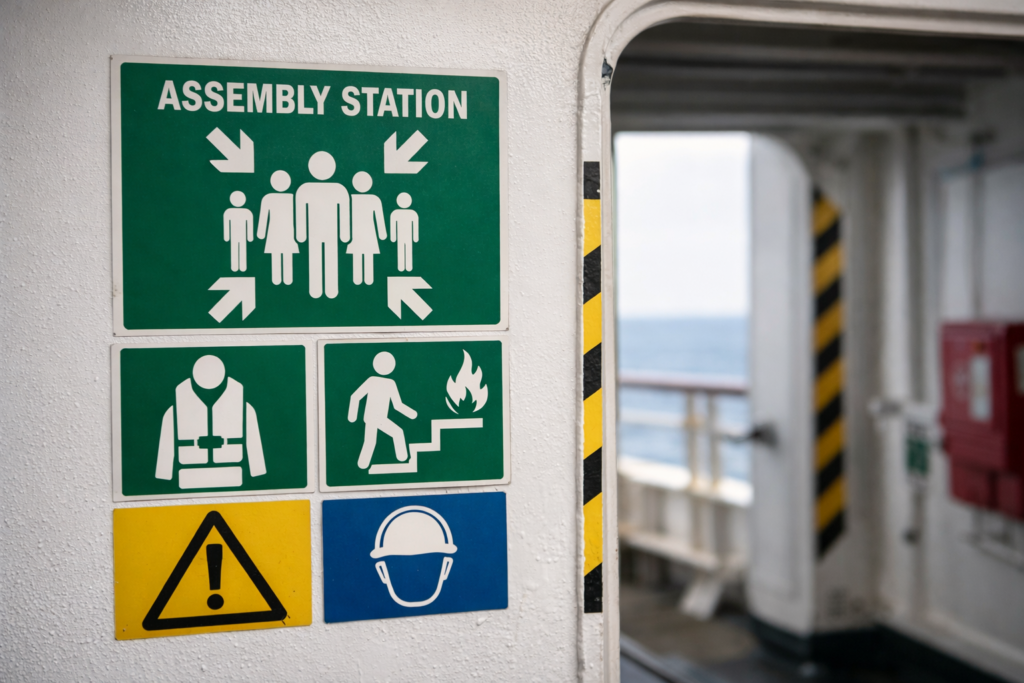
* Adequate equipment (lifeboats, life jackets, fire protection systems)
* Regular safety drills
* Mandatory crew training
* Fire prevention and evacuation procedures
Its primary goal is to protect human life in emergency situations.
However, SOLAS does not regulate labor rights nor does it address conditions related to gender inequality, harassment, or sexual and reproductive health. This does not mean that women are not protected under SOLAS; rather, it reflects the absence of an explicit gender perspective in its design.
The convention assigns primary responsibility to the flag state, while port states may conduct inspections in cases of non-compliance. In practice, when crews are multinational and companies operate across multiple jurisdictions, this structure can create grey areas regarding accountability.
Labor Rights at Sea: The MLC 2006
The Maritime Labour Convention (MLC 2006) of the International Labour Organization was conceived as a “bill of rights” for people working at sea.
It consolidates and modernizes labor standards related to:
* Employment conditions
* Health and safety
* Accommodation
* Food
* Rest
* Inspection and complaint mechanisms
It is one of the most important international instruments regulating maritime labor.
However, when analyzed from a gender perspective, significant gaps emerge. The convention does not explicitly refer to women workers nor does it develop provisions that take gender differences into account.
Although it establishes principles of non-discrimination and fair working conditions:
* It does not explicitly address sexual harassment or gender-based violence
* It does not include provisions related to sexual and reproductive health
* It does not provide specific measures for pregnant workers or those with care responsibilities
The convention establishes a system of shared responsibilities among:
* The flag state
* The port state
* The seafarer’s country of origin
However, Uruguay has not ratified the MLC 2006, meaning that its provisions are not part of the country’s binding legal framework.
An Ongoing Agenda in the Face of Women’s Participation
The documentary analysis confirms one of the project’s central assumptions: maritime labor regulations were designed in contexts of male predominance.
The incorporation of a gender perspective into these instruments is, in most cases, recent or marginal.
From the perspective of Transnational Social Protection, this raises key questions:
* What institutional resources are actually available to women workers?
* Which complaint mechanisms function effectively in practice?
* What role can ports and local states play?
* How are international conventions translated into effective protection during navigation?
Looking at what remains unseen also means reading what regulations still do not say.
An Invitation If you currently work—or have worked—on cruise ships, we would like to hear about your experience:
* Did you know which regulations governed your work during navigation?
* Who did you turn to—or who would you turn to—in case of a labor or health-related issue?
* Did you feel that complaint mechanisms were accessible and effective?
Reference
Zorrilla, V., & Rau, H. (2022). Legal aspects of cruises on the Uruguayan legal system. In Global Studies in Comparative Law (Vol. 56). Springer.